
Media Narrative: Between Tinubus Birthday and the Lynching of Northerners in Uromi
By Yushau A. Shuaib
In school, we are taught that the mediaoften described as the Fourth Estateexists to educate, inform, and serve as a watchdog for society. Yet behind this noble ideal lies a troubling reality: media narratives are frequently shaped by the interests of their proprietors, patrons, and editors. Even on deeply sensitive national issues, editorial direction can be swayed by commercial gain, political allegiance, or ethnic loyalties.
The ongoing Russia- Ukraine war, as I discussed in a recent article, starkly illustrates the hypocrisy and bias in global media coverage. Western outlets routinely suppress narratives sympathetic to President Vladimir Putin, just as some Eastern media demonise President Volodymyr Zelensky. Today, journalistic ethics are too often sacrificed for partisan interests. The once-vaunted integrity of global journalism is steadily eroding, compromised by ideological alignment and the influence of sponsors.
Sadly, the Nigerian media is no exception. Ownership and editorial control increasingly dictate which stories are amplified and mutedparticularly on issues involving ethnoreligious tension and national security.
I have always found it challenging to watch graphic footage of human brutality. The lynching of Deborah Samuel Yakubu, a Christian student accused of blasphemy in Sokoto in May 2022, remains etched in my memory. Her horrific killing received widespread media coverage, with headlines invoking religion and regional identityIslam, the North, and Christianity. In sharp contrast, that same month, Harira Jibril, a pregnant Muslim woman, and her four children were murdered in Anambra, allegedly by IPOB militants. This atrocity received scant media attention and, when reported, conspicuously lacked references to her faith or origin. The disparity reveals deep-rooted biases in our medias treatment of ethnoreligious violence.
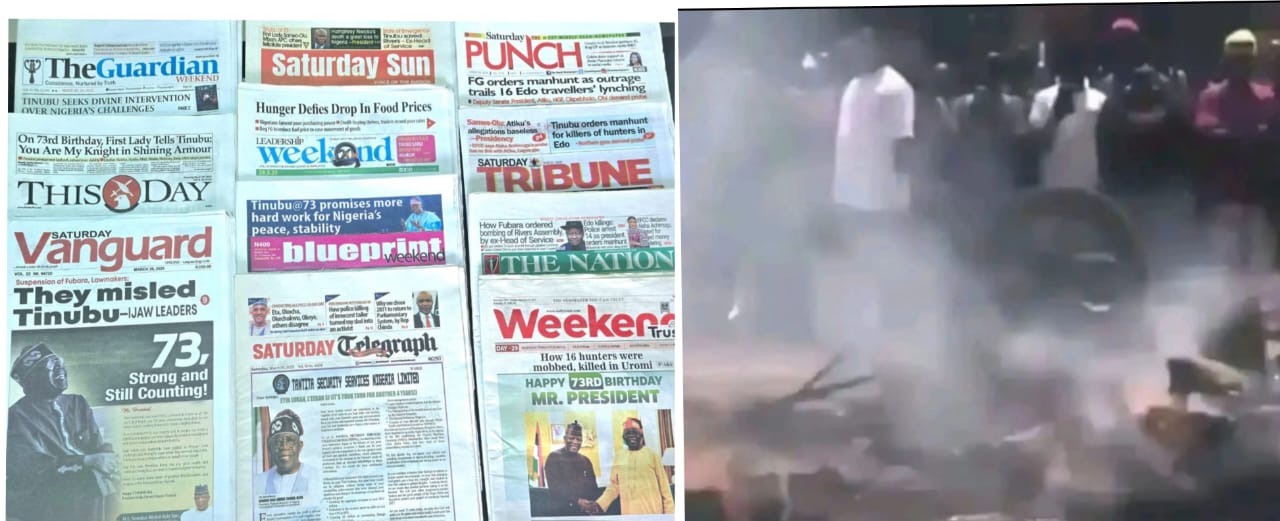
A more recent and equally distressing case underscores this troubling trend: the lynching of Northern hunterspredominantly Hausa-speaking Muslimsin Uromi, Edo State, on Thursday, March 28, 2025. The victims, reportedly en route to Kano for Eid al-Fitr celebrations, were travelling in a truck when local vigilantes intercepted them and allegedly found dane guns. This sparked a mob attack. A harrowing video showed the men pleading for mercy as they were beaten and burned alive, while onlookers stood by with chilling indifference.
President Bola Ahmed Tinubu promptly condemned the killings, describing them as shocking and unacceptable, and ordered a thorough investigation and prosecution. He reaffirmed that jungle justice has no place in a civilised society and that all citizens have the right to move freely within the country.
Despite the horror captured on video, most national newspapers downplayed the incident. Shockingly, the atrocity was eclipsed by frivolous matters that received more prominent coverage.
Read Also:
On Saturday, March 29the day after the lynchingI visited the PRNigeria Centre in Abuja to review the major national dailies. To my dismay, front pages were dominated by paid advertorials celebrating President Tinubus 73rd birthday. These glossy tributes, sponsored by political allies and business elites from both the North and Southincluding High Chief Government Tompolo and Senator Abdulaziz Yari Abubakarcompletely overshadowed the tragedy in Uromi.
Newspapers like ThisDay, The Guardian, Vanguard, Saturday Sun, Saturday Telegraph, Leadership Weekend, and even Blueprint Weekend either buried the story deep within their pages or ignored it entirely. Their front pages focused on far less urgent matters: the death of Humphrey Nwosu, political wrangling in Rivers State, forest reserve issues, and women in leadership.
Only four publicationsSaturday Punch, Saturday Tribune, The Nation, and Weekend Trustgave the incident the seeming prominence it deserved, with headlines such as: FG Orders Manhunt as Outrage Trails 16 Edo Travellers Lynching, Tinubu Orders Manhunt for Killers of Hunters in Edo, Edo Killing: Police Arrest 24 as President Orders Manhunt, and How 16 Hunters Were Mobbed, Killed in Uromi.
Yet even these reports by the four newspapers omitted a critical detail: the victims were Northern Muslims. If the roles had been reversedwith Southern Christians lynched in the Norththere is little doubt that ethnic and religious profiling would have been amplified, generating widespread public outrage.
Several factors fuel this persistent media bias, including ownership influence, where proprietors and sponsors shape narratives to align with their interests; lack of diversity, as many newsrooms are dominated by personnel from a single region, leading to skewed perspectives; and commercial priorities, where advertising revenue and political patronage often outweigh the public interestas evident in the prioritisation of birthday tributes over national tragedies.
Such editorial decisions erode public trust in the media and deepen societal divisions. The press should serve as a bridge between Nigerias diverse communities, not a wedge.
It is also a public reality that Northern voices are becoming increasingly marginalised in mainstream media. Southern interests dominate most print, electronic, and online platforms. Northern elites, for their part, have failed to invest meaningfully in media ventures, often underestimating the strategic importance of media in shaping public opinion and promoting regional representation.
This recent episode underscores how media framing can shape national consciousness. When tragedies are filtered through biased lenses, they reinforce dangerous stereotypes and widen Nigerias fragile fault lines.
The Nigerian Press Organisation (NPO), Nigerian Guild of Editors (NGE), and the Guild of Corporate Online Publishers (GOCOP) must urgently address these imbalances. Proactive measuresincluding more inclusive hiring, stricter editorial guidelines, and greater accountabilityare essential. A more balanced media is not just desirable; it is vital for national cohesion.
By acknowledging the current shortcomings and advocating for ethical, sensitive journalism, we can begin to foster mutual understanding and reflect the true diversity of our nation.
As I posted on Facebook, the murder of Northerners in Edo is not only horrifyingit is a national tragedy. As we recently observed both the holy month of Ramadan and Lent, let us pray for peace and justice. But beyond prayers, we must actcollectively and conscientiouslyto prevent future ethnoreligious violence and forestall retaliatory cycles. Let wisdom prevail.
Yushau A. Shuaib
Author of Award-Winning Crisis Communication Strategies
www.YAShuaib.com, [email protected]